
- Becoming independent from glasses and lenses
- Increase visual acuity and quality of vision by treating small optical defects that cannot be corrected with conventional glasses, by treating the patient's optical aberrometries by performing a tailor-made treatment guided by the topography of the cornea.
- Contact lens intolerance or history of keratitis
- Correct certain diseases of the surface of the cornea (hereditary dystrophy responsible for recurrent keratitis, Cogan's disease, etc.)
- Avoid the risk of infection associated with regular contact lens wear. (NB: a contact lens wearer has a much higher risk of developing an eye infection than with a single laser procedure, which guides the decision when it is possible to carry out permanent laser treatment)
- Easier practice of certain sports: swimming, mountain biking, jogging, etc.
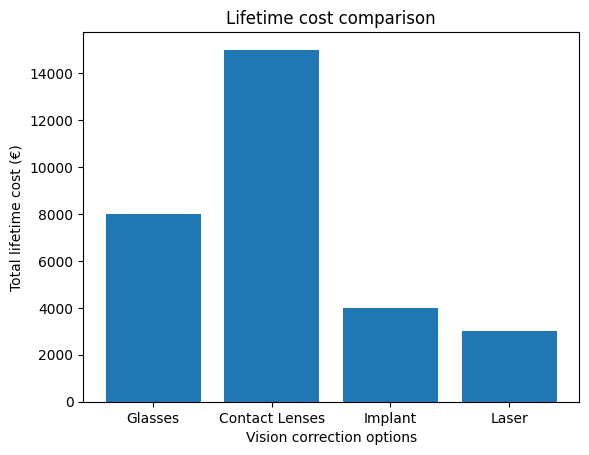
- Make significant savings in the long term because you no longer need to regularly change glasses or lenses
- Professional indications requiring good vision without glasses (selection criteria for the navy, police, etc.)
The economic advantage:
Besides its speed and efficiency, this procedure offers several other advantages.
Comfort: After the procedure, patients appreciate waking up in the morning without having to wear glasses or contact lenses.
Less dependence: Imperfect vision makes glasses or contact lenses very dependent. You have to think about them constantly, and many people feel uncomfortable when they forget them.
Superior safety compared to contact lenses: Today, we are more aware of the risks associated with contact lenses. A lens is a surface on which bacteria can adhere and multiply. They can then enter the eye and cause scarring. Some people can even lose their sight. The risk of infection is much lower with laser treatment.
More economical in the long run: Glasses and contact lenses represent an ongoing cost. A pair of glasses can cost between €3,000 and €15,000 over a lifetime. Contact lenses are even more expensive: their cost is estimated at between €15,000 and €30,000, including cleaning products and consultations.
Laser treatment is usually only needed once and costs between €3,500 and €4,300 for both eyes. However, this treatment is rarely reimbursed, and not all health insurance plans cover it.
Is the result permanent?
The eye remains stable after laser treatment. However, it's important to remember that it's a biological organ that can change throughout life. But if your vision has been stable for two years and your myopia is less than -6 diopters, the risk of further vision loss after the procedure is less than 1%.